

Hydrotherapy and Aquatic Physiotherapy
Hydrotherapy Costs in Australia - Everything you need to know
A guide to leveraging water’s buoyancy, resistance, and warmth for rehabilitation and pain management, supervised by qualified professionals.
If you’re exploring hydrotherapy to support chronic pain, recovering from surgery, or managing a long-term health condition, it’s important to understand the costs.
While these can vary significantly across Australia, knowing your funding options and what represents good value can help you access the care you need without financial stress.
What is Hydrotherapy and Why is it Beneficial?
Hydrotherapy, also known as aquatic physiotherapy, is a form of treatment that uses the properties of water to assist in rehabilitation and pain management.
Performed in a heated pool, hydrotherapy leverages the water’s buoyancy, resistance, and warmth to create a supportive environment for exercise.
The buoyancy of water reduces the load on joints, making it easier and less painful to move for individuals with arthritis, post-surgical stiffness, or chronic pain conditions.
The warmth of the water helps to relax muscles and ease joint stiffness, while the water’s resistance can be used to build muscle strength and improve cardiovascular fitness.
Hydrotherapy is prescribed and supervised by qualified professionals, such as accredited exercise physiologists or physiotherapists, to ensure that the exercises are tailored to your specific needs and goals.
It is used to treat a wide range of conditions, including:
- Arthritis and other rheumatic conditions
- Chronic pain, including back pain
- Recovery after surgery, such as joint replacements
- Neurological conditions like stroke, Parkinson’s disease, and multiple sclerosis
- Musculoskeletal injuries
Typical Costs Across Australia
The cost of hydrotherapy in Australia is not standardised and can differ based on several factors, including your location, the type of provider you see, and the format of the session.
Generally, sessions in major metropolitan areas like Sydney and Melbourne tend to be more expensive than in regional centres.
Hydrotherapy vs Swimming
Individual Sessions with Exercise Physiologists or Physiotherapists
One-on-one sessions with an exercise physiologist or physiotherapist offer the most personalised level of care.
These are ideal when you are starting hydrotherapy, have complex needs, or are in the early stages of post-surgical rehabilitation.
An initial consultation is almost always required to assess your condition, discuss your goals, and develop a tailored treatment plan.
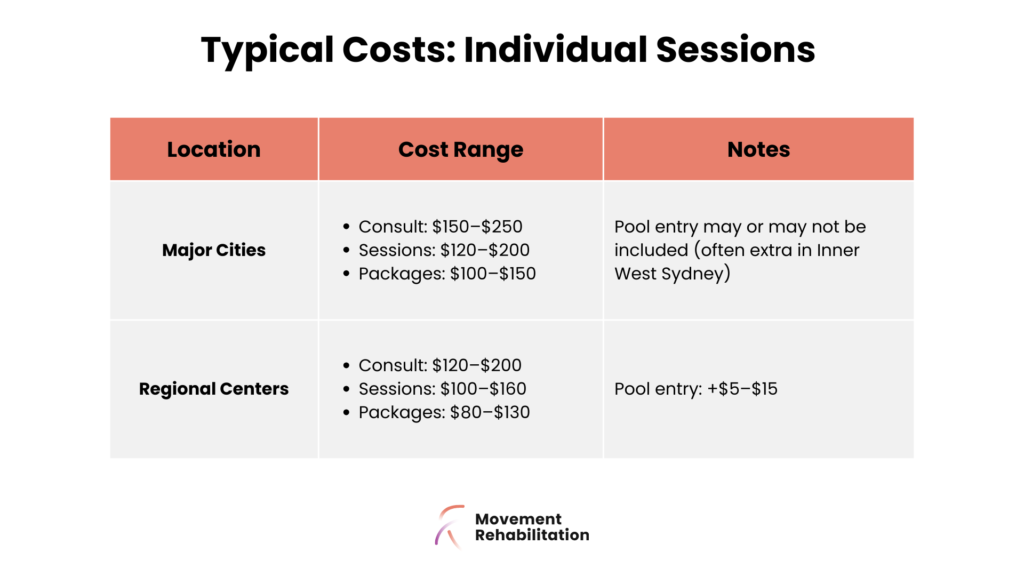
Here is a general guide to the costs you can expect for individual sessions:
Major Cities (Sydney, Melbourne, Brisbane, Perth, Adelaide):
- Initial Consultation: $150-$250 (60-90 minutes)
- Individual Sessions: $120-$200 per hour
- Package Deals: $100-$150 per session when purchasing multiple sessions
- Pool Entry Fees: May or may not be included depending on the provider and location (in many city areas, such as Sydney’s Inner West, pool entry is typically charged separately).
Regional Centers:
- Initial Consultation: $120-$200
- Individual Sessions: $100-$160 per hour
- Package Deals: $80-$130 per session
- Pool Entry Fees: May be additional $5-$15
Group Classes and Programs
Group hydrotherapy classes are a more affordable option and can provide a social and motivational environment.
These classes are often tailored to specific conditions, such as arthritis or back pain, and are led by a qualified professional.
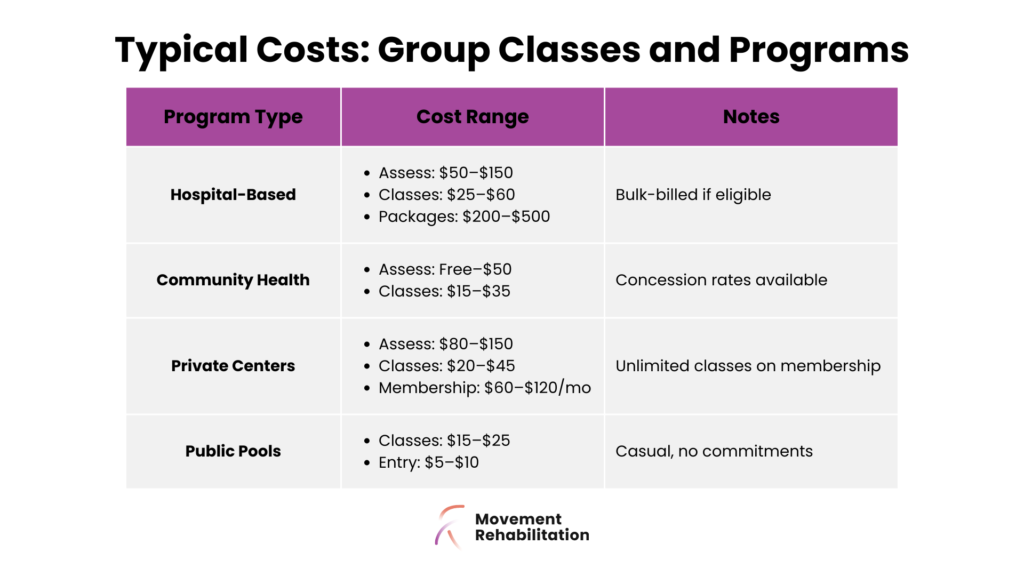
The cost of group sessions varies depending on the setting.
Hospital-Based Programs:
- Assessment: $50-$150 (often bulk-billed if eligible)
- Group Sessions: $25-$60 per class
- Program Packages: $200-$500 for 8-12 week programs
Community Health Centers:
- Assessment: Often free or low-cost ($20-$50)
- Group Sessions: $15-$35 per class
- Concession Rates: Available for pensioners and low-income earners
Private Aquatic Centers:
- Assessment: $80-$150
- Group Sessions: $20-$45 per class
- Membership Options: $60-$120 per month for unlimited classes
Public Pool Programs:
- Class Fees: $15-$25 per session
- Pool Entry: $5-$10 additional
- Casual Rates: No long-term commitments required
Medicare Coverage
Medicare provides subsidies for hydrotherapy for individuals with chronic health conditions through the Chronic Disease Management (CDM) plan, formerly known as the Enhanced Primary Care (EPC) plan.
To be eligible, your GP must diagnose you with a chronic condition (one that has lasted for at least six months) and create a specific GP Management Plan and Team Care Arrangement.
Under a CDM plan, you can be referred for up to five subsidised allied health sessions per calendar year. This can include services from a physiotherapist or exercise physiologist for hydrotherapy.
As of 2024, the Medicare rebate is approximately $58.00 per session. You will typically have to pay the full fee to the provider and then claim the rebate from Medicare, leaving a ‘gap’ payment.
Some providers may offer bulk billing, meaning you have no out-of-pocket expense, but this is becoming less common.
Chronic Disease Management (CDM) Plans
Medicare can cover hydrotherapy under specific circumstances:
Eligibility Requirements:
- Chronic Condition: Must have a diagnosed chronic condition (arthritis, diabetes, heart disease, etc.)
- GP Management Plan: Your GP must develop a Team Care Arrangement or GP Management Plan
- Allied Health Referral: Specific referral to an eligible provider
Coverage Details:
- Sessions Covered: Up to 5 allied health sessions per calendar year
- Rebate Amount: $56.35 per session (as of 2024)
- Provider Requirements: Must be Medicare-eligible Exercise Physiologist or Physiotherapist
- Gap Payments: You’ll typically pay the difference between the provider’s fee and Medicare rebate
How to Access:
- Discuss with Your GP: Explain your condition and interest in hydrotherapy
- Obtain Referral: Get a formal referral under a CDM plan
- Find Eligible Provider: Ensure your chosen provider accepts Medicare
- Claim Rebate: Either bulk-billed or claim rebate after payment
Enhanced Primary Care (EPC) Plans
Similar to CDM plans, EPC plans are for people with complex care needs:
- Higher Rebates: Slightly higher Medicare rebates available
- More Sessions: Potentially more than 5 sessions in exceptional circumstances
- Team Approach: Coordination between multiple health professionals
Private Health Insurance
If you have ‘extras’ cover as part of your private health insurance policy, you may be able to claim a benefit for hydrotherapy.
Coverage is typically provided under the physiotherapy or exercise physiology category. The amount you can claim depends on your level of cover and your insurer.
Private health insurance coverage for hydrotherapy varies significantly:
Extras Cover:
- Physiotherapy Benefits: Most extras policies cover physiotherapy, which may include hydrotherapy
- Exercise Physiology: Increasingly covered by major insurers
- Annual Limits: Typically $300-$1,500 per year for allied health services
- Waiting Periods: Usually 2-6 months for new policies
What’s Typically Covered:
- Individual Sessions: Usually covered under physiotherapy or allied health benefits
- Assessment Fees: Often covered as part of treatment
- Pool Entry Fees: May or may not be included
What’s Usually Not Covered:
- Group Classes: Often considered fitness rather than therapy
- Maintenance Programs: Long-term wellness programs may not be covered
- Travel Costs: Transport to facilities not covered
Maximising Your Benefits:
- Check Annual Limits: Understand your yearly allowance
- Provider Networks: Some insurers offer higher rebates for preferred providers
- Pre-Approval: Some treatments may require pre-approval
- Claim Timing: Consider timing of claims to maximise annual benefits
NDIS Funding
The National Disability Insurance Scheme may fund hydrotherapy for eligible participants:
Funding Categories:
- Core Supports: Daily living activities that hydrotherapy directly supports
- Capacity Building: Improved health and wellbeing outcomes
- Capital Supports: Potentially funding for home hydrotherapy equipment
Evidence Requirements:
- Allied Health Assessment: Professional recommendation for hydrotherapy
- Goal Alignment: Clear connection to NDIS goals and outcomes
- Cost-Effectiveness: Demonstration that hydrotherapy is reasonable and necessary
Typical Funding Scenarios:
- Individual Sessions: Often funded for people with significant disabilities
- Group Programs: May be funded as social and community participation
- Equipment: Funding for home spa or pool modifications in some cases
Workers' Compensation and Insurance
If your condition is work-related, additional funding may be available:
Workers’ Compensation:
- Full Coverage: Often covers all reasonable treatment costs
- No Gap Payments: Usually no out-of-pocket expenses
- Extended Treatment: May fund longer treatment periods than other schemes
Motor Vehicle Accident Insurance:
- CTP Insurance: Covers treatment for motor vehicle accident injuries
- TAC (Victoria): Transport Accident Commission provides comprehensive coverage
- icare (NSW): Covers motor vehicle and workplace injuries
Pre-Approval Requirements:
- Medical Reports: Detailed reports supporting hydrotherapy need
- Treatment Plans: Specific goals and expected outcomes
- Provider Approval: Ensure your chosen provider is approved by the insurer
Department of Veterans' Affairs (DVA)
Veterans may access hydrotherapy through DVA funding:
Gold Card Holders:
- Full Coverage: All reasonable treatment costs covered
- No Gap Payments: Direct billing to DVA
- Comprehensive Care: Integration with other DVA health services
White Card Holders:
- Condition-Specific Coverage: Only for accepted conditions
- Limited Scope: May not cover all hydrotherapy needs
Self-Funding Strategies
If you’re paying out-of-pocket, consider these strategies:
Cost-Reduction Options:
- Group Classes: Significantly cheaper than individual sessions
- Package Deals: Many providers offer discounts for multiple sessions
- Off-Peak Times: Some facilities offer reduced rates for less popular times
- Student Clinics: University programs may offer supervised services at reduced rates
Budgeting for Treatment:
- Initial Investment: Plan for higher costs in the first month (assessment + initial sessions)
- Ongoing Costs: Budget for regular sessions over several months
- Maintenance Phase: Consider long-term costs for ongoing management
Value Considerations:
- Cost per Benefit: Compare the cost to potential medication savings
- Quality of Life: Consider the value of pain relief and improved function
- Prevention: Early intervention may prevent more expensive treatments later
Financial Assistance Programs
Several organisations provide financial assistance for health treatments:
Arthritis Australia:
- Equipment Loans: Free loan of mobility aids and equipment
- Information Services: Free resources and support
- Local Programs: Some state offices offer subsidised programs
Condition-Specific Charities:
- MS Australia: Support for people with multiple sclerosis
- Parkinson’s Australia: Resources and sometimes financial assistance
- Stroke Foundation: Support for stroke survivors
Community Foundations:
- Local Grants: Small grants for health and wellbeing activities
- Service Clubs: Rotary, Lions, and other clubs sometimes provide health funding
- Religious Organisations: Some churches and religious groups offer health support
Conclusion
Understanding the costs of hydrotherapy—and how they vary by location, provider, and funding option—can help you make informed decisions about your care.
While prices differ, the value lies in improved mobility, pain relief, and a faster path to recovery when programs are chosen wisely.
If you’d like clear advice on fees, rebates, or funding options available for your situation, contact our team at Movement Rehabilitation. We’ll walk you through your choices and help you find a cost-effective plan that supports your health goals.